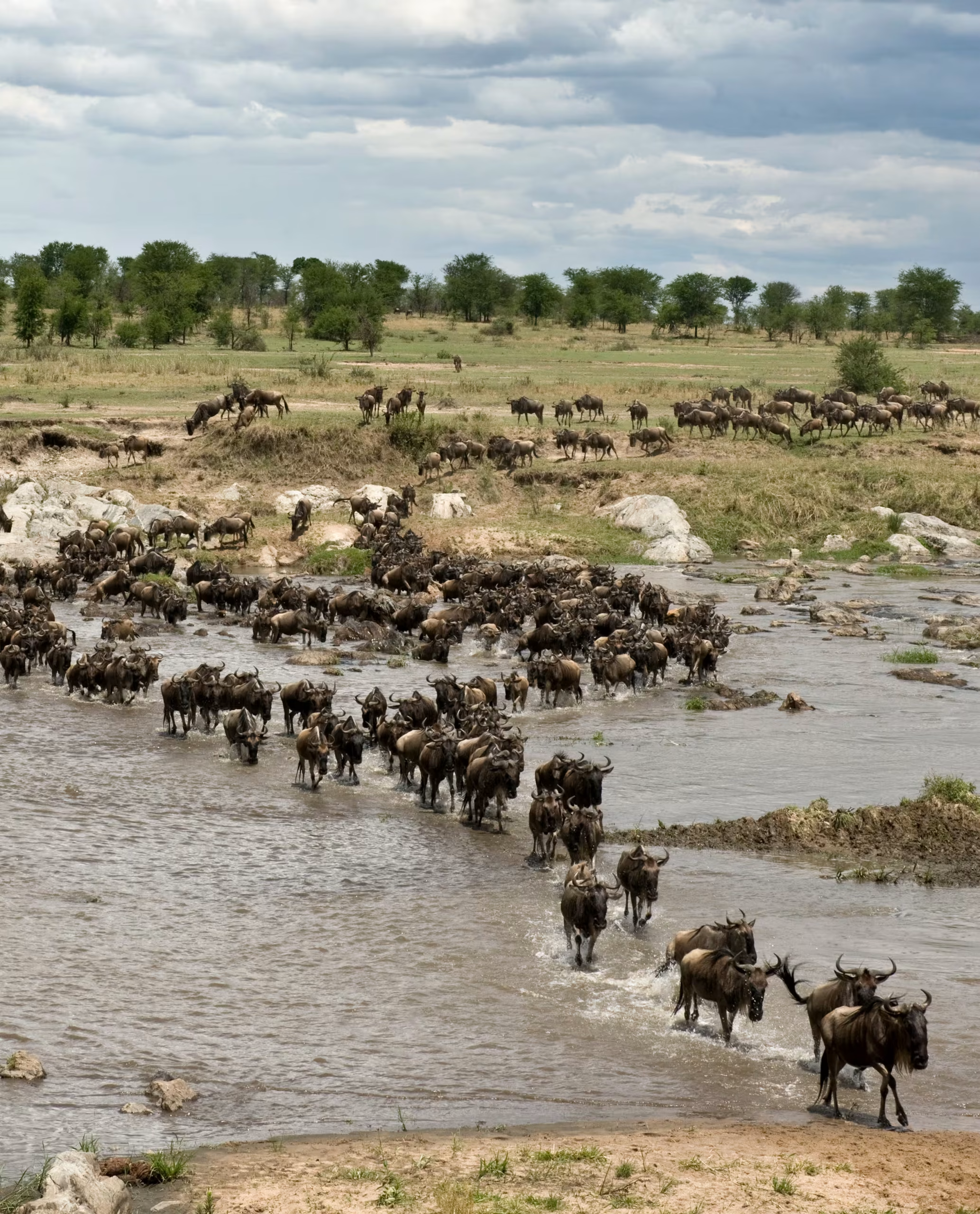
Two million animals,
one endless circle
The Great Migration is Earth's largest mass movement of land mammals — roughly 1.5 million wildebeest and 250,000 zebra circling the Serengeti-Mara ecosystem every year, following the rains and grass. It happens in the Serengeti, year-round. The trick is knowing where.
The most misunderstoodphenomenon in Africa
The Great Migration is one of the most-asked-about and least-well-understood phenomena in African travel. It is not an event that happens once a year. It is a continuous circular movement that happens every day of every year — wildebeest and zebra following the rains and the fresh grass around an ecosystem the size of Wales. What changes month to month is not whether the migration is happening, but where.
The full cycle: January-March, the herds are in the southern Serengeti and Ndutu plains, calving — 500,000 newborns in three weeks, the highest density of predator action on the continent. April-May, the herds move west toward the Grumeti River. June-July, they cross the Grumeti and continue north. July-October, the most dramatic phase: river crossings of the Mara River in northern Serengeti, with massive crocodiles. November-December, the herds return south to the calving grounds and the cycle begins again.
The most important question for a migration safari is: when can you travel? Once we know the dates, we design the itinerary to position you in exactly the right part of the Serengeti at exactly the right time. Mobile tented camps move with the herds. Fixed lodges work for certain windows. A 7-10 day migration safari, designed around your dates, can put you in front of the action every single morning.
What makes thisexperience itself
The Calvingjan-mar
The Grumetijun-jul
The Mara Crossingsjul-oct
The Return Southnov-dec
The best parksfor this experience
Serengeti — Southern (Ndutu)
Calving Jan-Mar, returning herds Nov-Dec
Explore park → 02Serengeti — Western (Grumeti)
Grumeti River crossings Jun-Jul
Explore park → 03Serengeti — Northern (Kogatende)
Mara River crossings Jul-Oct
Explore park → 04Serengeti — Central (Seronera)
Resident wildlife year-round, transit zone
Explore park →Depends entirely on what you want to see. River crossings: July-October (northern Serengeti). Calving: late January-mid March (southern Serengeti). Quiet alternative: November-December (returning herds).
What thisactually involves
Wildlife is unpredictable — even with perfect positioning, river crossings can happen suddenly or wait days. We position you in the right zone; the migration provides the show.
Things travellersoften ask
Ready forgreat migration safaris?
Tell us your dates and what matters most. We design every Great Migration Safaris itinerary personally.